
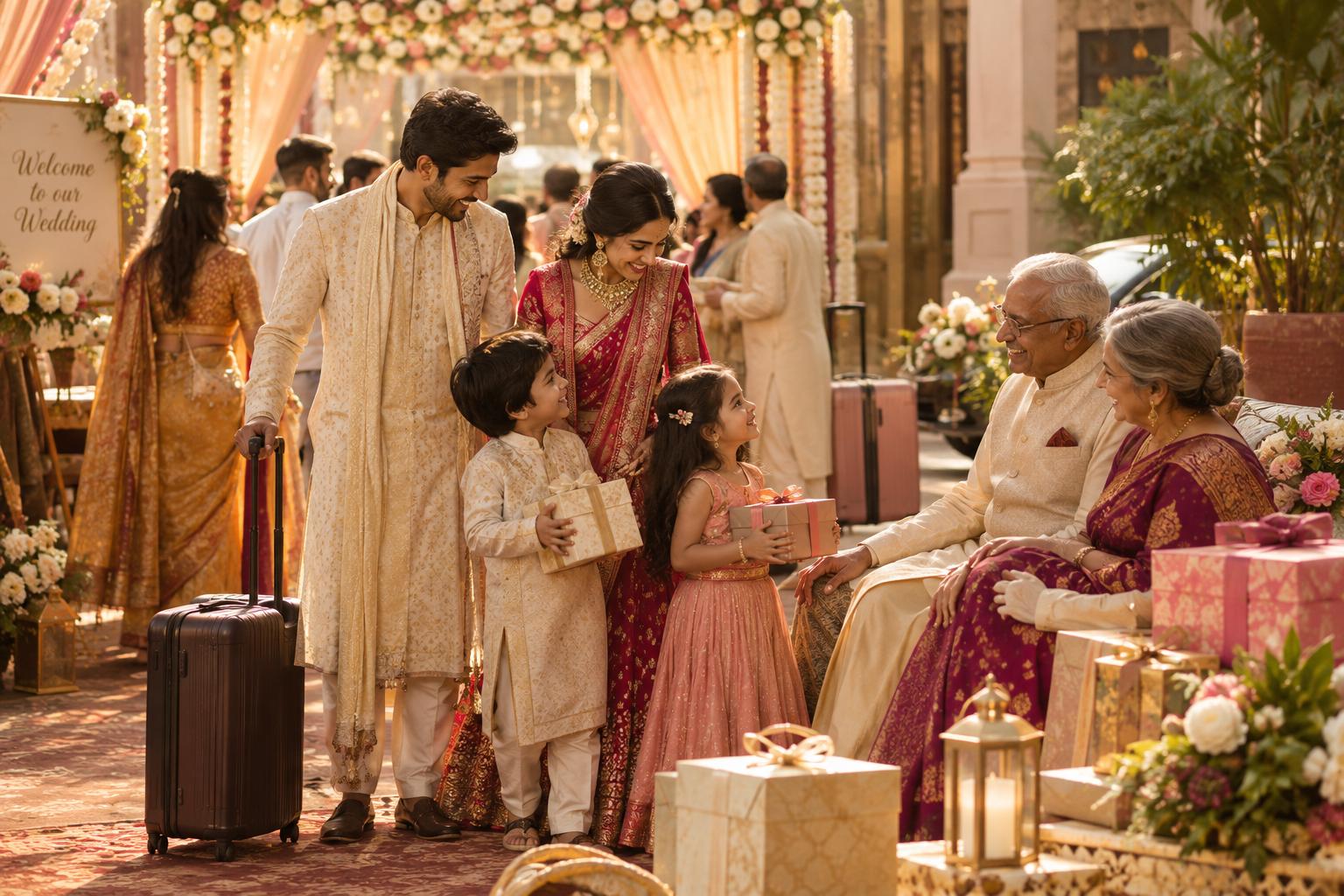
Shaadi Season: Stop Losing Bags, Gifts & Kids
Wedding season and festival travel in India means packed trains, crowded mandaps, and a dozen relatives' luggage that looks the same. Here's how to stop losing things — without handing out your phone number.
Why Wedding & Festival Season Is Peak "Lost Item" Season in India
Think about a typical shaadi season week. You're on an overnight train with three generations of family. Every bag is the same shade of blue-and-black checked cloth your massi bought in bulk from Sadar Bazaar. You're switching between the groom's house, the venue, and a relative's flat, unpacking and repacking at each stop. Kids are running between the mandap, the buffet, and the dance floor while the adults are busy with rituals.
Add Diwali, Durga Puja, or a big joint-family Ganpati trip on top of that, and you get the same pattern: more people, more luggage, more unfamiliar spaces, less attention on any one bag.
It's not carelessness. It's just math — the more hands and homes an item passes through, the more chances it has to get left behind, picked up by mistake, or handed to the wrong person.
The Most Common Things That Go Missing During Shaadi & Festival Season
1. Look-Alike Luggage
Every family seems to buy the same three suitcase colours. At a wedding with 50–100 guests moving between venues, hotels, and homes, bags get swapped constantly — usually by accident, at the cloakroom, in the tempo traveller boot, or outside the mandap.
What helps: A QR luggage tag on the handle means whoever ends up with the wrong bag can scan it and message the real owner immediately, instead of guessing whose it is.
2. Return Gifts and Shagun Envelopes
Return gift boxes, mithai packets, and shagun envelopes get placed on common tables, then picked up in the wrong order as guests are leaving. A gift meant for one family sometimes leaves with another.
What helps: A small QR sticker on gift boxes headed to out-of-town relatives means if a box gets separated from its recipient, it can find its way back — without a single awkward phone call asking "did you get an extra box?"
3. Kids at the Venue
At any function with a hundred-plus guests, a decorated hall, and a buffet line, it takes about ninety seconds for a child to wander off toward the dance floor or the dessert counter. Most of the time it's harmless — but those ninety seconds are genuinely stressful for a parent.
What helps: A wearable QR tag on a child's wrist or clipped to their outfit means any guest, waiter, or venue staff who notices a child alone can scan it and reach a parent directly — instead of making an announcement or searching the crowd themselves.
4. Elderly Relatives at Unfamiliar Venues
Weddings often mean elderly parents and grandparents travelling to venues, hotels, and cities they don't know well. Large, unfamiliar crowds and long events can be disorienting.
What helps: A Dibbzy tag on a bag, walking stick, or clipped to clothing gives any concerned guest or staff member a fast, private way to alert a family member — without needing to know who's related to whom in a hall full of strangers.
5. Hotel Room and Homestay Items
Between the mehendi at one venue, the sangeet at a banquet hall, and the wedding at a farmhouse, families often shift between two or three stay locations in a single trip. Chargers, jewellery pouches, and small bags get left behind in hotel rooms or relatives' guest rooms constantly.
What helps: Housekeeping staff or the next guest in that room are far more likely to actually return something if there's an instant, no-hassle way to contact the owner — versus it sitting in a lost-and-found drawer for weeks.
Why "Just Write Your Name and Number on It" Doesn't Work Anymore
The old advice — write your name and phone number on a luggage tag with a permanent marker — has two real problems during wedding season specifically:
Privacy in a crowd of strangers. Weddings bring together your family's contacts and venue staff, vendors, drivers, and other guests' extended families — many of whom you're meeting for the first time. Handing your personal number to a wide, mixed crowd isn't something most people are comfortable with.
It fades, and it's slow. Ink rubs off after one train journey. And even when it's legible, most people hesitate to cold-call a stranger's number — a scan-and-message flow gets a far higher response rate than a printed number ever does.
How a QR Tag Fixes This — Without an App or a Number Swap
A Dibbzy QR tag works the same way whether it's on a suitcase, a gift box, a child's clothing, or an elderly relative's bag:
You attach the tag before you travel — takes under a minute.
Someone finds it — a fellow guest, hotel staff, a relative, anyone.
They scan it with any phone camera. No app to download, no account needed on their end.
They send a message through a secure page. They never see your actual phone number or email.
You get notified instantly and can reply, arrange pickup, or just confirm everyone's safe.
The whole thing works for the length of the trip and stays useful long after — the same tag protects your bag on your next work trip or your kid's next school outing too.
A Shaadi Season Tagging Checklist
Before your next wedding trip or festival travel, here's what's worth tagging:
Every checked-in suitcase — especially if it's a common colour or pattern
Gift boxes and shagun packets going to out-of-town relatives
Kids' outfits or a wristband for the main event day
Elderly relatives' bags or walking aids, especially at venues they haven't visited before
Your own carry-on and jewellery pouch — these get set down and forgotten more than any other item during a busy event day
Hotel room key-cards or pouches, if your family is juggling multiple rooms
Traditional Methods vs. QR Tags — During Travel Season Specifically
Situation | Without a tag | With a Dibbzy QR tag |
|---|---|---|
Two identical suitcases swapped at the venue | Guests call around, ask in the family group chat, hope someone notices | Finder scans the tag, messages the real owner directly |
Gift box separated from its recipient | Awkward calls asking who has what | Scan, message, sorted — no phone numbers exchanged |
Child wanders off at a crowded function | Search the hall, ask around, make an announcement | Any guest or staff can scan and alert a parent in seconds |
Elderly relative's bag left in a cab or hall | Depends entirely on the finder's honesty and effort to trace it | Finder is guided straight to a private contact page |
Item left in a hotel room between venue changes | Sits in lost-and-found, may never be claimed | Housekeeping scans, owner is notified same day |
Conclusion
Wedding and festival season packs more people, more luggage, and more unfamiliar venues into a few intense weeks than the rest of the year combined. That's exactly the environment where things go missing — not because people are careless, but because there's no fast, private way for a finder to reach the right person.
A QR tag closes that gap before the season even starts. Tag the bags, the gift boxes, the kids' outfits, and your elderly relatives' essentials once, and you're covered for every function, every venue change, and every train journey this season throws at you.
Explore Dibbzy QR tags → (Keychains, luggage tags, pet tags, stickers, and premium metal tags — starting from ₹399)
Dibbzy
Author
Published on September 19, 2026
Frequently Asked Questions
Does a QR tag work if I'm travelling between cities during wedding season?
Can I use one tag for both the wedding trip and everyday use afterward?
Will guests or vendors see my personal number if they scan a tag on a gift box?
Is a QR tag safe to put on a child's clothing?
What if I only need a tag for the wedding season and not long-term?
More Articles
Still have questions?
Contact Us